Timetable
Log in to star items.
Time zone: UTC

Prospective authors are invited to meet with one of the co-editors of Narrative Culture, a journal affiliated with ISFNR.
Drop in if you would like to learn more about the focus and mission of the journal, what to consider when submitting, and what happens after you submit your work.
You can also receive feedback on specific ideas for individual articles or special issues.
Students, early career scholars, and anyone interested in publishing their work in Narrative Culture are encouraged to attend.
‘When the whole earth was so overrun…’ Folk narrative collections as more-than-human ethnographies
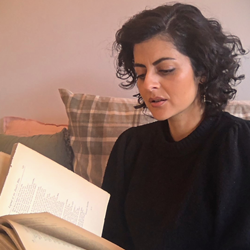
Tina Paphitis is Associate Professor in Cultural Studies, University of Bergen. She is a folklorist, with backgrounds in archaeology and critical heritage studies. She works at the intersection of folklore studies and environmental humanities, with particular attention to the relationships between narratives, landscapes, and the more-than-human. Her specialisms include legends and landscapes of Britain and the Nordic region, environmental folklore, experimental and experiential fieldwork methods, and the use and representation of folklore and archaeology in fantastic literature. She is keen on the role that folklore and folklore studies can play in addressing local and global challenges, and on amplifying diversity, equality, and inclusion in folklore studies.
Log in to access the recording...
Folklorists have long had an interest in beings beyond the human, crucially, entangled with human communities and local environments. Within folk narratives and their performative worlds, ‘supernatural’ beings are not only connected to humans and their environments, but are also shown to have complex social lives that reflect the lived experience of place and landscape. This paper explores collections from the British Isles to elucidate how the socionatural lives of supernatural beings are documented, described, and connected to the everyday lives of humans. Focusing on Robert Kirk’s The Secret Commonwealth (c. 1691) from Scotland, Michael Aislabie Denham’s ‘tracts’ (1846-59) of northern England, and John Rhŷs’s Celtic Folklore: Welsh and Manx (1901), it examines the narrative strategies that collectors employ in presenting folk narratives that amount to what we might conceptualise as ethnographies of the supernatural nonhuman. Through this ethnographic lens, we can understand folk narrative collections as bioculturally diverse texts that help us rethink hitherto reductive notions of supernatural beings as mere reflections of nature, instead emphasising their relationality. Simultaneously, they illuminate how nonhumans may be understood on a vernacular level, resisting scientistic categorisations that further separate human and nonhuman into culture and nature. In this way, this paper contests the notion that all western communities – especially so-called ‘modernising’ and ‘modern’ – view and engage with the world in nature-culture binaries. By reconfiguring ideas of supernatural beings in this way, we are better able to dissolve such binaries, emphasising relational entanglements and thinking more deeply about the naturecultures of supernatural beings.


Professor Gísli Sigurðsson will introduce the exhibition and traditional artists and folklorists, such as Atli Freyr and Einbreið brú, will engage with willing participants through song and dance at the Ýmir café.
Please sign up here.Participation is not limited, but we would like to split the crowd into groups so that the different areas would not be too crowded.
Join a guided nature-cultural walking tour of seaside Reykjavik to the geothermal beach in Nauthólsvík. Starting at the University Centre (Háskólatorg) folklorist Einar Skúlason will guide participants by foot through the history, land- and seascape of Reykjavík’s southern shore. At the destination resort, while relaxing on the beach, hot tubs, sea and sauna, you can enjoy a presentation of UNESCO inscribed Icelandic swimming culture, by our foremost specialist, Prof. Valdimar Hafstein; Accompanied by the ambient waves of folklorist and musician Rauður.
The pool will not be closed to public during our visit, and fits up to 100 people.


Price for swimming: 12 EURO paid on location
Departure from main entrance to the University Centre (Haskólatorg) at 17:00 Duration 2 to 3 hours (of which approx. 1 hour walking).
Bring sensible shoes and a bathing suit.
Please sign up here.Participation is not limited, but we would like to know how many to expect.
Hop on a ferry to Viðey Island, just off the north coast of Reykjavík. There, folklorist Björk Bjarnadóttir, will guide you through the island’s local flora and echoes of ancient cloister life. Viðey Island is one of Iceland’s most historic places, its archaeological remains dating back to Iceland’s settlement period.
Register here

The ferry, Skrúður, leaves, for a 20 minute cruise, from Aegisgardur [https://maps.app.goo.gl/hJmQsdja1PAjACCV6] in Reykjavík’s old harbour at 17:30 and returns home 19:00
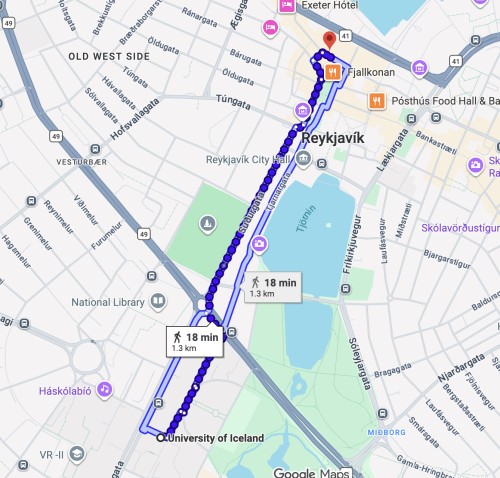
The harbour is about a 25-35 minute walk from the campus. The keynote ends about an hour before departure, so please bear in mind that you have to make your way to the harbour in time.
Price: 35 EURO for the ferry ride, paid via the registration link by June 11th.
Please note this tour is dependent on registration and weather.
Please make sure to pay the fee promptly. The boat is limited to 62 people - if we see that places fill up quickly, we will book a larger boat and reopen the registration. We will reassess this on Monday, June 8. If we do not get enough registrations/fees are not paid/tour is cancelled, paid delegates will be refunded.
Hólavallagarður and the Pond
Hólavallagarður is the second oldest graveyard in Reykjavík (1838–1932) and is covered in beautiful flora and old graves. It's right next to the university campus and offers a beautiful, tranquil space to walk around. There one will find memorials to a few famous Icelanders with informational plaques. Going downtown from there, you go past the city pond that is brimming with bird life at this time of year.
The Rainbow Street
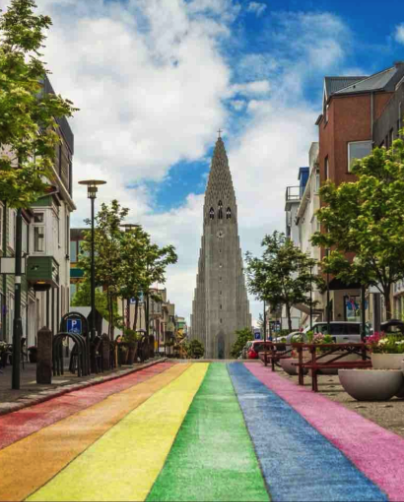 When downtown we recommend a walk up Skólavörðustígur, better known as the rainbow street. There are many shops, cafés, restaurants and bars along that street, one of them being 12 tónar, a record shop, bar and café. There one can find a wide selection of both new and used records. The store was founded in 1998 and has since become the country's most popular record shop. There it's also nice to sit down and have a drink, as they have a good selection of coffee, tea, and beer. If you're there before 18:00 you can also pop in to Handprjónasambandið (e. Handknitting association) and buy a handmade Icelandic sweater there.
Hallgrímskirkja / Skólavörðuholt
At the end of the rainbow street stands Hallgrímskirkja, the big church that can be seen from campus. It is possible to go up to the tower for a fee, but it can also be really nice to just walk around the church and surrounding area.
Mánudjass – LeKock
At 20:00 on June 15th there is a free jazz concert at the restaurant and bar LeKock, which is located at Tryggvagata 14, close to the old harbor and Hafnarhúsið. On your way there we recommend walking through "the rock village", a historic neighbourhood in Reykjavík. If you need a new perfume for the Conference Closing event a good place to look is Fischersund in the village.
Bíó Paradís
Showing of the FIFA World Cup on June 15th, free entry. Bíó Paradís is an old movie theater in downtown Reykjavík that often shows artistic and international films and hosts film festivals. They also have a bar on site.
Seaside Walk
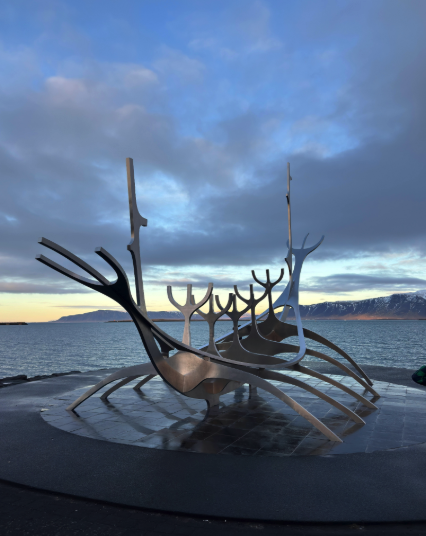 Enjoy the evening sun and view of the mountain Esja. Visit the famous sculpture Sólfarið (e. Sun Voyager) or walk around the old harbour and visit Þúfan by Ólöf Nordal, celebrating the old Icelandic tradition of drying fish by the seaside.
Public Pools
Vesturbæjarlaug is the closest public pool to the university area and has a newly refurbished sauna area with dry sauna, infrared sauna as well as a beautiful steam bath, swimming pool and plenty of hot tubs. Seltjarnarneslaug is another choice close by with views out to the ocean, and Laugardalslaug is one of the most popular pools for a good reason.
Pub Crawl
Start with Skúli, a craft beer bar located in a historic plaza near the oldest cemetery in Reykjavík. Then walk to Ægir, a folklorist favourite microbrewery with historical themes — try the national food if you're feeling brave! If you want a more quiet experience with fine wines, Port 9's sommeliers can bring you exactly what you need, and if the weather is nice you can sit up on the roof. Lastly, 22 is a historic LGBTQIA+ bar with cocktails and beer.
Restaurants
On campus you can find Stúdentakjallarinn, or the Student Cellar, which is both affordable and good. You could also try some locally inspired small plates at the old West Side's Forréttabar. The langoustine soups at the Sea Baron in the old harbour area are also a big draw. Close by you can get a taste of Napoli in Reykjavík at the popular Flatey pizza. Alternatively walk downtown for a slice of pizza, and more, at one of the oldest restaurants, Hornið. Food courts are numerous and spacious throughout the city including Grandi Mathöll and Hafnartorg at the harbour, Pósthús Food & Bar near the town square and Hlemmur Mathöll at the east end of our main shopping street Laugarvegur. The brave can grab a garlic burger, or Forget-me-not, at the formidable Vitabar.
Nature in Narrative: Ontology, Semiotic Repertoires, and Their Entanglement with Discourse
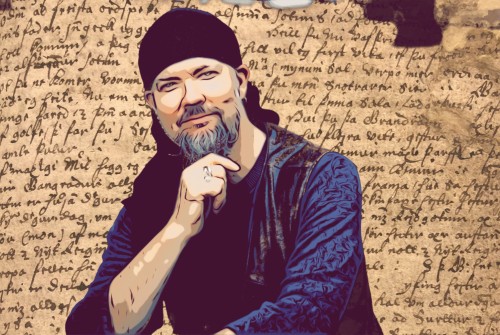
Frog is a folklorist based at the University of Helsinki. He completed his PhD at University College London in Scandinavian Studies in 2010 and docentships in both Folklore Studies and Scandinavian Languages at the University of Helsinki and in History of Religions at Stockholm University. He is a member of ISFNR's Executive Committee, Chair of the Folklore Fellows, and Editor-in-Chief of the monograph series FF Communications, among other positions. His work is characterized by interdisciplinarity with emphasis on empirically grounded theory and methodology. Although he has worked with a variety of traditions across his career, medieval Icelandic and Scandinavian traditions and the large corpora of non-modernized Finno-Karelian traditions remain cornerstones for his empirical research from cultural reconstruction to current reception and reinvention.
This paper explores nature and its relationship to narrative in non-modernised traditions in terms of ontology. The central traditions of reference are those of medieval Icelandic literature and non-modernised Finno-Karelian traditions documented mainly in the nineteenth and twentieth centuries. It begins by looking at the construction, through discourse, of features of the environment commonly considered ‘nature’, such as thunder, forests, animals, and so on. The various examples are used to highlight that the paper approaches ‘nature’ from an etic perspective. This provides a platform for opening a critical perspective on the ideologies of modernity that have constructed ‘nature’, and furthermore on how these ideologies of otherness may be entangled with ‘narrative’ as a means of characterising folklore genres of knowing the world.
Rather than considering ontology in its potential breadth, the paper considers the more particular phenomena of vernacular physics and vernacular physiology, in order to examine how these are entangled with forms of discourse. It aims to illustrate some of the ways in which these operate as implicit frames of reference for meaning-making that underpin narration. From vernacular physiology, the paper moves on to consider categories of being, in the sense of agents, drawing on concepts of perspectivism and mythic ethnography to examine the boundaries between humans and non-humans in the construction of the world.
Considering different types of beings opens onto their societies, the places associated with them, and the semiotic repertoires through which tensions between sameness and otherness are managed — a process described here as otherworlding. Bringing these several threads together, the paper returns to the ideologies of modernity, the rise of interest in ‘nature’, and the interest in engaging with the semiotic repertoires of various traditions as resources in the present.
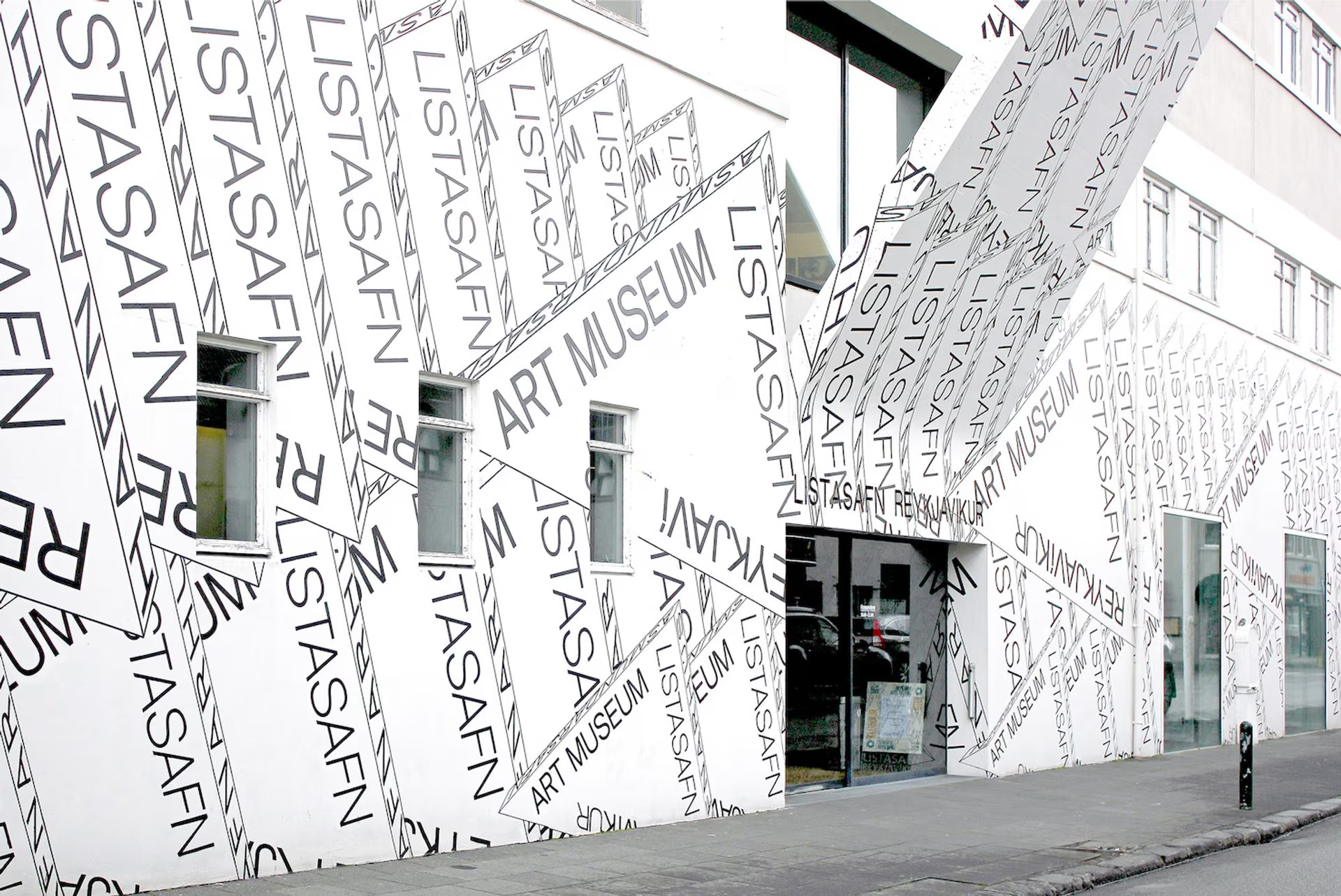
Join us in the hall of Reykjavík Art Museum's Hafnarhús for welcome drinks, a variety of finger foods, and musical performances by Rauður, Funi, Atli Freyr, and the Vaka group. Later in the evening, a DJ will take over and keep the party going as we dance the night away.
See you there!
Please take a look at the individual events on the timetable to sign up for the cultural events. Some of them are with limited spots, so make sure to sign up early.
The cultural program will be woven into Reykjavík itself, inviting you to explore the city and its vibrant urban character. Enjoy guided city walks, discounted entry to some of Iceland’s many museums, and a mix of traditional and contemporary music, dance, and art. We’ll kick things off with an opening reception and wrap up with a lively final celebration for all participants. Along the way, social events will make it easy to connect, share ideas, and spark early-career opportunities. The conference will also include carbon-offsetting measures to help ensure a more sustainable experience for everyone.
Since June 17th is Iceland’s National Day, we encourage you to stay a little longer to soak up the city-wide festivities. For those who enjoy craft beer, Reykjavík’s excellent brewery scene offers plenty of chances to sample local flavours. You can also take advantage of discounted excursions, whale-watching adventures, and optional sea or geothermal-pool dips, because when in Iceland, why not?
June 17 is the National Day of Iceland, celebrating Icelandic independence and national pride with festive events throughout Reykjavík and across the country. There will be a parade from Hallgrímskirkja, concerts, street theater, dance parties, circus shows, food trucks, and vintage car exhibitions at Hljómskálagarður and Klambratún and more. One of the highlights of the day is the appearance of the Fjallkona (“Lady of the Mountain”), a symbolic figure representing Iceland. Conference guests are warmly encouraged to enjoy the celebrations, and further information about the program in Reykjavík city center can be found here: https://reykjavik.is/en/june17
International Sustainable Gastronomy Day If still in town check out International Sustainable Gastronomy Day, a walking tour and plant tasting will be offered at the Nordic House. During the walk, led by Borgarnáttúra – Urban Biodiversity, we will identify plant species and discuss the vegetation around the area. The walk starts by the Nordic house at 17 on Tuesday, June 18th. Participation is free and everyone is welcome! This event is organized in collaboration between: The Nordic House, Borgarnáttúra – Urban Biodiversity Iceland, Slow Food Iceland, W.O.M.E.N. in Iceland and Plantan Bístró. https://nordichouse.is/en/event/natures-menu-a-day-of-sustainable-gastronomy/