Timetable
Log in to star items.
Time zone: Europe/Lisbon
Moderators:
Meghan Ference (Brooklyn College, CUNY)
Wangui Kimari (American University Nairobi Abroad Program)
Discussants:
Andrea Pollio (African Centre for Cities and DIST)
Tatiana Thieme (University College London)
Bettina Ng'weno (University of California)
This event brings together five recent and forthcoming ethnographic books about Nairobi, a city that has long contributed to the production of urban theory. From Kenyan debates of the 1970s that operationalized the informal economy to the introduction of mobile money in the late 2000s, which provided a technological vocabulary for the World Bank’s financial inclusion agenda, few African metropolises have been so generative of conceptual vocabularies that have subsequently travelled far beyond the city itself.
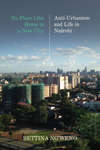
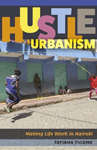
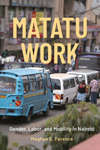
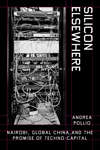
Ngweno’s No Place Like Home in a New City, Ference’s Matatu Work, Thieme’s Hustle Urbanism, Pollio’s Silicon Elsewhere, and Kimari’s forthcoming Mo-Faya continue this tradition while approaching Nairobi through different ethnographic articulations of urban life, spanning questions of home, mobility, work, technology and ecology. Together, they offer new grammars for thinking with Nairobi’s multiplicity while attending to the labours, movements, infrastructures and everyday sociality through which the city is continually made and remade.
Staged as a conversation between authors and discussants, the panel asks what emerges when different ethnographic readings of Nairobi are brought into conversation, and what it means to take the city seriously as a site of pluriversal theory-making. How do concepts emerge from sustained engagement with particular urban worlds, and what happens as they travel beyond them? At the same time, what might these different readings reveal about a city that resists any single conceptual framing?
![]() |
Hustle Urbanism By Tatiana Thieme |
![]() |
Matatu Work By Meghan E. Ference
|
![]() |
No Place Like Home in a New City By Bettina Ng'weno |
![]() |
Silicon Elsewhere By Andrea Pollio |

![]() |
Mo-Faya: Socio-Ecological Survivals in Nairobi’s Outlaw Settlement By Wangui Kimari |
This workshop, organised by the Journal of Modern African Studies (JMAS) with the support of ECAS, offers early-career researchers participating in ECAS 2027 an opportunity to develop articles for possible submission to the journal and to receive feedback and advice from members of the JMAS editorial team and Editorial Board. Participation in the workshop does not guarantee publication in JMAS. Any manuscript subsequently submitted to the journal will be considered through the journal’s normal editorial and peer-review processes.
We welcome papers across disciplines, methodological approaches, topics and African regions. Applicants should already have collected the principal data or source material for the paper and have a good understanding of the relevant field and literature. Preference will be given to projects that are sufficiently advanced to benefit from focused discussion of their argument, evidence and contribution.
The workshop will take place during the afternoon prior to the first day of the conference. It will combine presentations and feedback on participants’ projects, discussion of articles published in JMAS, dedicated writing time, and one-to-one conversations with editors and Editorial Board members.
Applicants should send a detailed 2–3 page summary of the proposed paper, setting out the research question or problem, data or source material, methods or approach, central argument, and intended contribution to the relevant literature. Applications should also include a short biographical note and institutional affiliation.
Please send applications to JMAS at jmodafstudies(at)gmail.com by 30 March 2027.
Applicants will be notified of the outcome by 30 April 2027.
The workshop is open only to participants registered for ECAS 2027. There is no additional fee for participation in the workshop.
How do you communicate research effectively to busy policy makers? This practical masterclass helps researchers identify policy relevance, formulate compelling key messages and communicate findings clearly to non-academic audiences – without compromising scientific quality or nuance.
More details on how to participate TBC
This event launches three new books that together provide a prism on African history in its global entanglements. Focusing on palm oil, railways, and decolonization, the volumes foreground ordinary actors’ agency and reshape debates on extraction, infrastructure, and empire.
Chair: Rabea Rittgerodt
Discussants: Dmitri Van den Bersselaar, Omar Gueye
How do recent monographs on African colonial and postcolonial history reframe long-standing debates about development, infrastructure, and decolonization when viewed through the experiences of “common” people? This roundtable, organized as a joint launch of three new volumes published by De Gruyter, provides a prism on Africa’s entanglements with global political and economic projects.
Giovanni Tonolo’s "Rooted in Exploitation: Oil Palm Development in Twentieth-Century Dahomey/Benin" traces how long-term “development” produced different winners, losers, and in-between groups across changing economic and political regimes, revealing the social hierarchies embedded in extractive economies.
Friedrich Ammermann’s "Contested Imperial Infrastructure. A User’s History of the Cape to Cairo Railway in Southern Africa, 1889–1967" shifts the lens from ‘tools of rule’ to the practices of owners, operators, workers, and customers, showing how infrastructure was used, adapted, and contested on the ground.
Ngozi Edeagu’s "In Solidarity. The Elite Capture of Decolonisation in Nigeria, 1937–1963" moves beyond nationalist elites to recover the struggles of women traders, schoolchildren, ex-servicemen, and coal miners, whose demands were absorbed or marginalized as new political orders took shape.
Nordic Africa Institute/Bloomsbury Book Launch: Everyday Humanitarianism: Crisis, Care and Local Response in Tanzania
NAI launches the edited volume ‘Everyday humanitarianism: Crisis, Care and Local Response in Tanzania' that focuses on locally-led aid in response to crisis outside formal international structures. It challenges the traditional view of humanitarianism as solely international and North-South driven.
Convenors:
Lisa Ann Richey (Copenhagen Business School)
Peter Kragelund (Danish Institute for International Studies )
Consolata Sulley (University of Dar es Salaam )
Discussants:
Line Engbo Gissel (Roskilde University)
Herbert Hambati (University of Dar es Salaam)
Claire Mercer (London School of Economics LSE)
The book launched is based on a six-year collaborative research project (EHTZ) examining ‘everyday humanitarianism’, the informal, citizen-led actions of ordinary Tanzanians responding to acute and protracted crises outside formal aid structures. Set against a backdrop of severe Western funding cuts to the international humanitarian sector, seventeen Tanzania and European authors challenge conventional North–South, organization-centric frameworks that assume aid is an act of "rescue" directed at distant others. Instead, this book shifts the perspective to the Global South, focusing explicitly on local givers and their relationships with recipients. Using Tanzania as an illustrative case - a lower-middle-income nation with deep-rooted traditions of communal solidarity alongside nascent formal crisis response institutions. EHTZ has produced findings that contribute to our understandings of how we might need to rethink ‘humanitarianism’ as necessarily based solely on helping at a distance during generalizable situations of ‘crisis’; how ‘localization’ needs to rethink power relations also within the local; and finally, how citizen self-reliance and informal helping interacts and engages with – but does not challenge – the Tanzanian state. Thus, this project also highlights local understandings of care in crisis in ways that strengthen knowledge of Tanzanian state–society relations.
The Nordic Africa Institute and Bloomsbury will invite the editors, authors and discussants to launch the book at ECAS 2027.